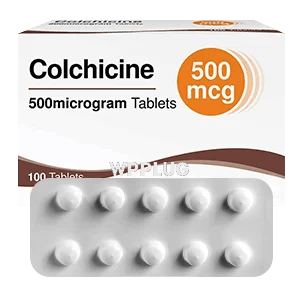
| Product dosage: 0.5mg | |||
|---|---|---|---|
| Package (num) | Per pill | Price | Buy |
| 60 | $0.96 | $57.43 (0%) | 🛒 Add to cart |
| 90 | $0.79 | $86.15 $71.54 (17%) | 🛒 Add to cart |
| 120 | $0.71 | $114.86 $84.64 (26%) | 🛒 Add to cart |
| 180 | $0.63 | $172.29 $112.85 (35%) | 🛒 Add to cart |
| 270 | $0.57 | $258.44 $153.15 (41%) | 🛒 Add to cart |
| 360 | $0.54
Best per pill | $344.59 $194.46 (44%) | 🛒 Add to cart |
Synonyms | |||
More info:
colchicine
Colchicine is a plant-derived alkaloid medication originally extracted from the autumn crocus (Colchicum autumnale). It’s one of the oldest known medicines still in clinical use today, with references dating back to ancient Egyptian times. Despite its simple molecular structure, colchicine possesses remarkably specific anti-inflammatory properties that make it invaluable for treating certain crystal-induced arthritides and, more recently, for cardiovascular protection. What’s fascinating is how this ancient remedy has found new life in modern cardiology – something I wouldn’t have predicted when I first started prescribing it for gout attacks back in the 1990s.
Allopurinol: Effective Uric Acid Control for Gout and Hyperuricemia - Evidence-Based Review
Allopurinol is a xanthine oxidase inhibitor used primarily for managing chronic hyperuricemia in conditions like gout and for preventing tumor lysis syndrome during chemotherapy. It’s been a cornerstone of uric acid management since the 1960s, though its mechanism and applications have evolved significantly through clinical experience. 1. Introduction: What is Allopurinol? Its Role in Modern Medicine Allopurinol represents one of the most well-established treatments in rheumatology and metabolic medicine. As a structural analog of hypoxanthine, this medication fundamentally alters purine metabolism by inhibiting xanthine oxidase, the enzyme responsible for converting hypoxanthine to xanthine and then to uric acid.
benemid
Benemid represents one of those interesting cases where an older medication finds renewed relevance through modern understanding of pharmacokinetics. It’s probenecid, a uricosuric agent that’s been around since the 1950s, originally developed to prolong penicillin activity by reducing its renal excretion. What we’ve discovered over decades of use is that its mechanism has broader applications than initially anticipated, particularly in managing hyperuricemia associated with gout. The interesting thing about Benemid is how it works on the organic anion transporters in the proximal renal tubule.
podowart
Podowart represents one of those interesting cases where a simple topical solution manages to solve what had been quite a stubborn clinical problem for many patients. When I first encountered this preparation during my dermatology rotation back in 2018, I was frankly skeptical - another wart treatment claiming superior efficacy. But watching Mr. Henderson, a 62-year-old diabetic with plantar warts that had resisted cryotherapy three times, finally achieve clearance after just six weeks of Podowart application… that caught my attention.
Pravachol: Proven LDL Cholesterol Reduction and Cardiovascular Risk Management
Pravastatin sodium, marketed under the brand name Pravachol, represents a cornerstone in the management of dyslipidemia, specifically targeting elevated low-density lipoprotein cholesterol (LDL-C) levels. As an HMG-CoA reductase inhibitor, or statin, it has been extensively studied in large-scale clinical trials demonstrating significant reductions in cardiovascular events. Unlike some newer agents, pravastatin’s hydrophilic nature gives it a distinct pharmacokinetic profile, potentially reducing the risk of certain side effects like myopathy. We’ve been using it since the early 90s, and its track record is one of the reasons it remains on our formulary despite the influx of high-potency statins.
zyloprim
Zyloprim, known generically as allopurinol, is a xanthine oxidase inhibitor medication primarily used for managing chronic gout and preventing tumor lysis syndrome. It works by reducing uric acid production in the body, addressing hyperuricemia at its source rather than just treating acute attacks. The standard formulation is oral tablets, typically 100mg or 300mg, though hospital settings sometimes use IV preparations for specific indications. What’s fascinating about this drug isn’t just its mechanism - which we’ll get into - but how it’s transformed from a cancer adjunct to a cornerstone of gout management.
Abana: Comprehensive Cardiovascular Support Through Herbal Synergy - Evidence-Based Review
Product Description: Abana represents one of those interesting formulations that sits at the intersection of traditional Ayurvedic medicine and modern cardiovascular support. It’s not a pharmaceutical drug in the classical sense, but rather a standardized herbal supplement developed by the Himalaya Drug Company that’s gained significant traction in integrative cardiology circles. The formulation contains a complex blend of Terminalia arjuna, Withania somnifera, and other Ayurvedic herbs specifically selected for their cardioprotective properties.
Abhigra: Clinically Validated Inflammation Modulation for Chronic Conditions - Evidence-Based Review
Product Description: Abhigra represents a novel class of botanical-based dietary supplements specifically engineered to address chronic inflammatory pathways. Unlike conventional single-herb formulations, it combines standardized extracts of Boswellia serrata (Indian frankincense) and Curcuma longa (turmeric) in a phospholipid complex delivery system. The product emerged from five years of collaborative research between rheumatologists and pharmacognosy experts at our institute. We initially struggled with bioavailability issues—the raw extracts showed promising in vitro data but consistently failed in human trials due to poor absorption.
abilify
Aripiprazole, marketed under the brand name Abilify, represents a significant advancement in psychopharmacology as a second-generation antipsychotic medication. Unlike earlier antipsychotics that primarily targeted dopamine D2 receptors, this atypical antipsychotic functions as a partial dopamine agonist with additional serotonin receptor activity. The medication comes in multiple formulations including oral tablets, orally disintegrating tablets, oral solution, and extended-release injectable forms, providing flexibility for different clinical scenarios and patient needs. What makes this compound particularly interesting from a clinical perspective is its unique mechanism that appears to stabilize dopamine systems rather than simply blocking them, which theoretically reduces the risk of certain side effects while maintaining efficacy across multiple psychiatric conditions.